This serves as my proof that I am indeed James Schannep, posting as “schannepj” on reddit. You can see the post here, and feel free to ask me anything!
Tag: entertainment
Get INFECTED!
Whether you know it or not, this is the day you’ve been waiting for. This is the day I unveil the latest and greatest in storytelling technology. With INFECTED, the flagship book in the Click Your Poison series.
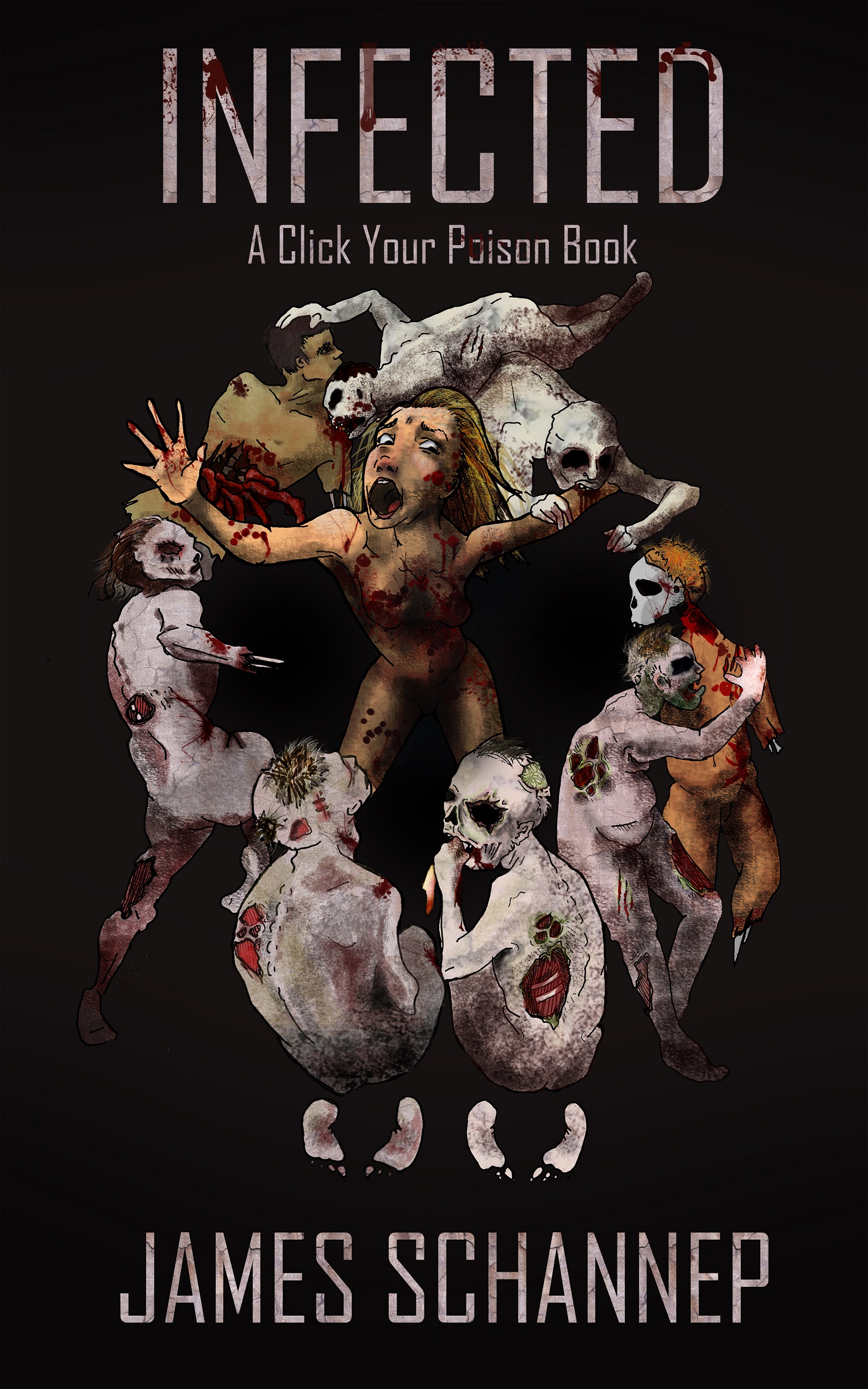
What is Click Your Poison? It’s the first gamebook series (a book in which YOU are the hero, and your choices directly influence the story’s progress) aimed directly for adults. What series like Choose-Your-Own-Adventure, Give Yourself Goosebumps, and Fighting Fantasy (UK) pioneered for children’s books in the 1980s & 90s, CYP now does for those fans who’ve grown up but still crave more.
Except now, as an ebook, you simply click your choice and the story flows forward for you. No flipping pages.
The first CYP book, INFECTED, allows you to answer the crucial question of our time–Will YOU survive the zombie apocalypse? Jump into the book right at the outbreak of a global zombie pandemic to learn how you’d fare against the walking dead. With over 50 possible endings and 3 unique storylines, you can pick up INFECTED a few minutes at a time on your smartphone, or dig deep on your tablet or PC… finally, a book with replay value.
I hope you have as much fun reading it as I’ve had writing it. The book’s PR campaign kicks off in the next couple of weeks, so this announcement is a special head’s-up for my blog’s community. Be the first of your friends to “Get INFECTED!”
Where to buy:
- Amazon.com Kindle Store
- Smashwords
- Barnes and Noble Nook
- Apple iTunes iBookstore (Coming soon!)
- Sony Reader Store (Coming soon!)
- Kobo (Coming soon!)
- The Diesel eBook Store (Coming soon!)
- Baker & Taylor’s Blio (Coming soon!)
- Axis360 (Coming soon!)
PS — Drop me a note, let me know how you like it!
Happy Published Author Day!
The first of my published works is now available to buy on amazon.com. Hooray!
Check out the awesome cover design by Allie Harold:
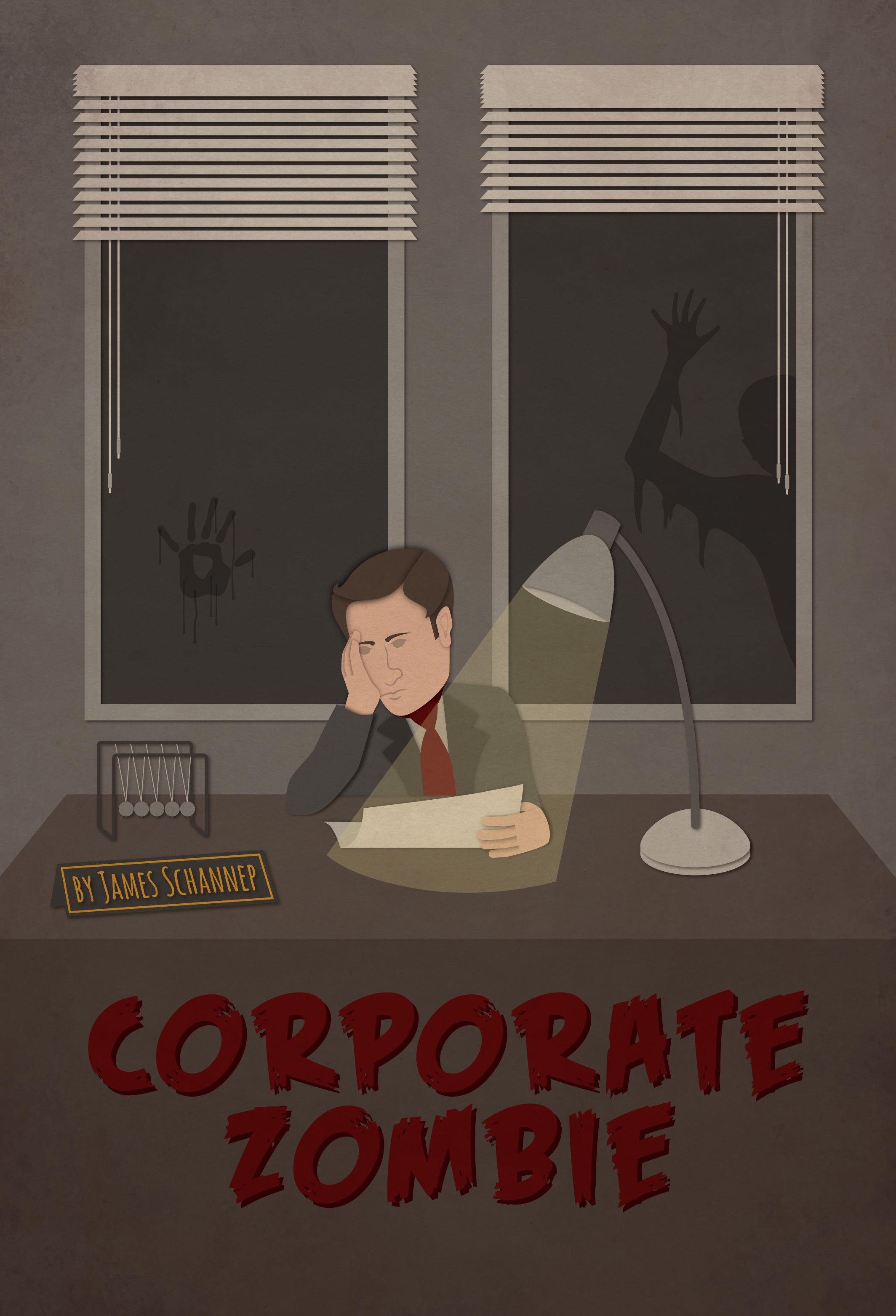
Yes, this is a piece of zombie fiction. No, it is not related to my impending book. “Corporate Zombie” takes place in a different world, with slightly different rules. Here, zombies may not learn, but they certainly never forget. And yes–that means zombie ninjas are possible.
It’s $1 to buy, or FREE if you’re a Prime member (don’t worry, Amazon still pays me even if you get it for free), so why not check it out?
And now, a little fun
I’ve been prepping non-stop for the release of my new book, so I figured I could use a little diversion. Somebody posted a link on facebook to I Write Like, a site where you can see what famous writer you compare most to. In their words, “Check which famous writer you write like with this statistical analysis tool, which analyzes your word choice and writing style and compares them with those of the famous writers.“
For me, I’m sure my style varies project to project, but I decided to give it a whirl for INFECTED, my imminent book. Choosing five different sections, I got four:

And one:
Obviously, I’m flattered. And it’s tempting to agree. Palahniuk’s writing is visceral, raw, darkly comedic, and a hell of a lot of fun to read–all qualifiers I aimed for on this project.
And DFW? Well, here’s what NPR said about him:
To read David Foster Wallace was to feel your eyelids pulled open. Some writers specialize in the away-from-home experience — they’ve safaried, eaten across Italy, covered a war. Wallace offered his alive self cutting through our sleepy aquarium — our standard TV, stores, political campaigns.
Writers who can do this, like Salinger and Fitzgerald, forge an unbreakable bond with readers. You didn’t slip into the books looking for story, information, but for a particular experience. The sensation, for a certain number of pages, of being David Foster Wallace.
Of course, it kind of feels like a horoscope reading, where everyone is fated to lead an awesome life. I mean, honestly, who’s going to balk at being compared to a pair of geniuses? Something tells me you won’t ever input your writing and see the result:
So, just for fun (and because I really needed a diversion), I dug up some old writing I worked on in middle and high school. Here was the result of the analyzed opening text:
Which more or less proves, in my opinion, that there’s no “bad answer” to the program. Either that, or I was a genius on the level of Joyce in grade-school. Ha.
Still, it’s a fun diversion. Give it a try, what results do you get?
113,000 words in 152 days
Okay, I haven’t posted in a while. Sorry about that, but I’ve got two really good excuses:
1) I’ve been busy scrawling away at my breakaway novel.
2) I’m getting married in… (let me check the calendar)… 7 days.
So, I’ve been a little busy. However, In keeping that this is a professional blog, let’s focus on #1.
Over the last five months, I’ve worked nearly every day with the goal of at least 1000 words. Looks like I averaged around 740–not bad considering I drove across the country, spent two months away from home, and was busy planning a wedding. Okay, to be fair, my fiance planned most of it.
Still! For the first time, I’m going to be a published writer. This is a certainty. Not because I’m sure I’ll woo an agent and a publishing house, but because I’m not even going to try. I’m self-publishing. I have a story that those in the biz (and people like me who want to be) call High-Concept. This means as soon as I tell you what it’s about, you’ll want to buy it. No matter that you’ve never heard of me and I have no track record; it’s that compelling. Scout’s honor.
It’s a zombie apocalypse story, I’ll say that much, but I’m not going to tell you what makes it so compelling just yet, not until the press release. Sorry.

Instead, I can tell you what to expect from here on out. 1) Updates about the progress of the book’s editing, cover development, and release schedule. There is still much work to be done before the release. If you want to subscribe (over on the right), you won’t miss a thing.
And 2) News on the short stories I’ll be publishing as ebooks in the upcoming weeks and months as well.
But you’ll probably get neither until after the wedding.
Here we are at the start of a journey. I’m glad you can join me!
Scripts vs Novels
Disclaimer: I am not a legal professional, and nothing found on this site should be taken as legal advice. Always consult an attorney.
I’ve already written about the differences of Screenwriting vs Prose from a writer’s perspective. Now I’d like to touch a little on the differences between the finished products: Scripts (screenplays) and Novels (books). Physically, here you go:


.
.
.
.
.
.
.
.
As for the format? There’s plenty of nuts and bolts books written on formatting screenplays and you can google manuscript specifications for agents or publishers (or ebook format), so if you’re looking for that, keep looking.
What I’d really like to talk about in this post is what the rights a writer keeps if they sell a script versus selling a novel.
Here’s what it boils down to: when you sell a screenplay, you are (generally) selling the whole thing. It’s no longer yours. Other writers can (and probably will) make changes to your story without your permission. When you sell a novel, you’re still the copyright holder and it’s still your writing, you’ve just given the publishing house the rights to print and sell it.
As a writer in the US, you have far more rights as a novelist than as a screenwriter. In Europe, screenwriters have more rights, but for this purpose–I’m talking only about American writers making deals with American production companies.
There are ways to keep certain rights to a screenplay, such as the extremely complicated Theatrical Separated Rights. On the flipside, there’s also terrifying loopholes like Hollywood Accounting, where you might never even get paid. For the most part, though, screenwriters aren’t even allowed to distribute the very scripts they wrote once they’re sold.
But as a novelist, you keep your copyright. Even if your book is getting adapted to film–in which case you only license the material to the studio, allowing them to make the film, much like you allowed a publisher to print the book.
Really, we can chase this rabbit down the hole as far as we want, but I think if we go much further we’ll need a pack of lawyers to read the map. So… that’s it for now.
Lesson learned: write the book first. Sell it twice, keep the rights!
Film Review: THE HUNTER (2011)
Disclaimer: I don’t plan on making film reviews the norm on this site but because I already wrote about this movie, I’m willing to make an exception. I also don’t like giving negative reviews, especially for independently financed projects, as I respect the difficulties of moviemaking and I don’t want to steer revenue away from these hard working artists. However, my audience is intelligent enough to know that this is only my opinion and that their own millage may vary. So we shall proceed.
Please be aware that SPOILERS will follow, so if you don’t want to ruin your Monet Experience then go watch the movie now (it’s currently playing VOD) and then come back and share your thoughts.
Here is the trailer for the movie:
The Hunter (2011) – Official Trailer HD
The trailer would have you believe it’s a tense thriller, right? About a man with a rifle, put in jeopardy by a conspiracy of those all around him–plenty of intrigue and suspense, right? Wrong. This 1:38 might be the most exciting of the whole 100 minute movie.
Okay, so maybe the problem was with marketing. Maybe if I knew I was getting into a slow, plodding drama more about unemployed loggers than a Tasmanian tiger hunt, I’d have enjoyed the experience more. But probably not.
Don’t get me wrong, this movie has its redeeming aspects. The cast was stellar! Defoe and O’Conner brought grace and strength. Sam Neil perfectly blended as a native (IMDB tells me he grew up down-under, so it’s no surprise). And what a beautiful film; the cinematographer expertly captured the breathtaking scenery.
I actually wish I liked this movie more. The topic is obviously one that interests me. But I just couldn’t get behind it. It strikes me as another in a painfully long line of films that tries to be profound by having nothing happen. It’s like someone who wants to write a great work of literature, so they decide step one is “don’t have a plot”.
A fellow friend and filmmaker once shared a bit of wisdom with me he learned while making a documentary on the Air Force Academy. He said, you can’t show the audience that an event is boring by boring them for ninety minutes. By the same token, I find that if you spend too much time building the atmosphere, you’re left with nothing but that.
So did I miss something? Or did the filmmakers?
A Monet Experience
Monet Experience (noun): The process or fact of personally observing, encountering, or undergoing something for the first time, or without any preconceived notion as to what might be entailed or encountered. To be a blank canvas. I went into the movie without even seeing the trailer, it was a total Monet Experience.

This is the coining of the term; its first non-spoken use. Monet, like me, often longed to see the world without any preconceived notions, prejudices, or expectation whatsoever. To see the world for the first time, like a child, but with an adult mind with the capabilities to appreciate such a thing.
When you taste a new dish for the first time, when you read a book with no idea what it’s about, when you visit somewhere you’ve never even seen pictures of — you’re having a Monet Experience. In the fashion of an Epicurean, I find no greater bliss than experiencing something new; no matter how small. So when I read that Monet felt the same way, it finally gave a name to what I’d been feeling all along.
“The noblest pleasure is the joy of understanding.”
– Claude Monet
And to be frank: I’m not narcissistic enough to call it a “Schannep Experience”. I like the name “Monet Experience”. Associating a man so full of passion, genius and talent adds an element of beauty to a concept near and dear to my heart.
As both a purveyor and rabid consumer of books and movies, a Monet Experience is essential to my enjoyment. Friends call me a “Story Purist” because I don’t like to know anything about a book or movie going into it. The writer intends information to be revealed in a specific way, and it tickles my senses for the process to unfold in such a manner. Spoilers, an apt name if ever one was writ, ruin that experience.
Ever watch a movie trailer, then say “Thanks for showing me the entire movie”? This is far too commonplace, in my opinion. Teasers do much better, but if I know I’m interested in something, I’ll skirt any conversation or exposure to that work.
“It’s on the strength of observation and reflection that one finds a way. So we must dig and delve unceasingly.” – Claude Monet
My love of the Monet Experience was cemented by a single event. I’ve served in the military, and during basic training we were cut off from the outside world. After we were able to leave the gates for the first time, I went to see a movie with a few friends. We had no idea what any of the films playing were about. “What should we see?” we asked one another aloud. A patron leaving said, “The Ring is a really great movie.” We all shrugged and bought tickets. It remains to this day one of my favorite movie-going experiences.
“So how do you pick movies and books?” you might ask. Simple: by recommendation. Trusted friends and critics say something is amazing and worth my time, and I check it out. Or by reputation. There are writers and filmmakers whom I believe produce quality art. Once I’m a fan, I’m hooked till they lose me.
Bottom line: Sometimes you can’t avoid the hype, but I find it more pleasurable not to seek it out. Give it a try. Only a Monet Experience can provide the joy of unadulterated perception.
© James Schannep and jamesschannep.com, 2011-2012. Unauthorized use and/or duplication of this material without express and written permission from this blog’s author and/or owner is strictly prohibited.
Book trailers
I have a friend who can’t seem to get behind the idea of a book trailer, so figured I’d put my thoughts out there and explain a bit about why I support them.
The easy answer — We live in an increasingly visual society, and a book trailer is a quick way to get people excited about books. Take this trailer for Stephen King’s Under The Dome for example:
I don’t own the rights to this, it’s merely an illustration.
Thirty seconds, and you’ve been good and teased on the book’s premise. What’s wrong with that? Well, as my friend would say, we’re trying to make books more like movies, and in doing so, robbing the reader of their own imagination. To put it bluntly: we’re catering to the illiteracy of our society.
Here’s why I disagree: I don’t see this clip as a “trailer” (as it’s billed), but as a commercial. Why shouldn’t books get advertisements? We can see “trailers” about housewives using laundry detergent without spoiling our own experience with the product. Otherwise books are advertised without actually telling us anything about the book. “Hey, a new thriller book is out.” If you don’t know the author, how do you know you’ll be interested?
I think book reviews are an excellent tool, but only insofar as you’re relying on someone’s opinion. With a commercial, you get a chance to see what the book is intended to be. It’s sort of like saying, “Here’s what I want to make you feel when you read this book. Does something like that interest you?”
So as I see it, book trailers are raising awareness. It’s up to the filmmakers to properly raise this awareness–to tease us–without spoiling the experience.
***update***
BONUS THOUGHT: After sleeping on it, I wonder if book covers didn’t experience a similar skepticism during the transition from plain-leather-binding to printed works of art. One could make a similar argument that cover art limits the reader’s imagination by introducing visual representations of characters and story world. Even so, one could make the case that cover art allows a potential buyer to instantly glean an understanding of what lies within the pages, and that book trailers are merely the next technological leap in this vein.
 Author James Schannep